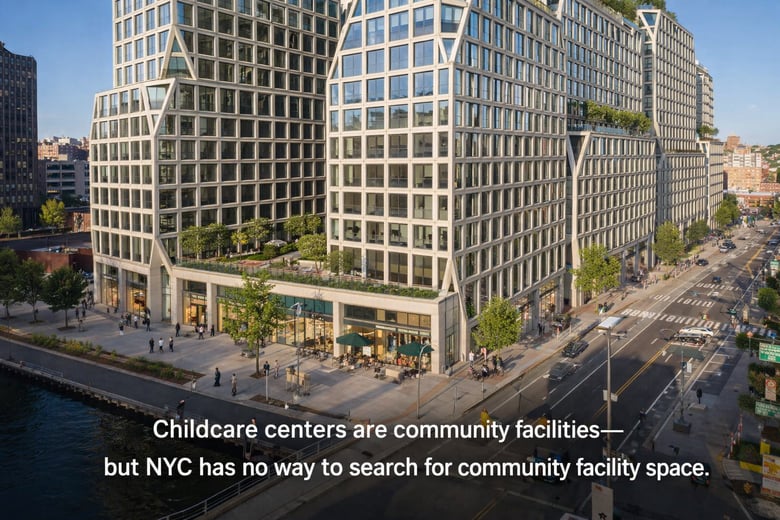
New York City has expanded tax abatements to support childcare—but without a way to find community facility–eligible space, the market can’t respond. This white paper explains why childcare real estate is a discovery problem, not a demand problem, and outlines a low-cost administrative fix.
Executive Summary
New York City has made meaningful progress in supporting early childhood education through expanded property tax abatements for buildings that create or expand licensed childcare centers. These abatements materially improve project feasibility for owners and developers. However, the policy stops short of addressing the core structural constraint in the childcare real estate market: childcare space is effectively invisible.
Licensed childcare centers are a community facility use under NYC zoning. Yet there is no public, searchable system that allows operators, landlords, or the public to identify where community facility–eligible space actually exists. As a result, the City is subsidizing a use that the market cannot efficiently locate.
This white paper connects three realities:
- The recent expansion of NYC’s childcare property tax abatements
- The zoning and physical realities of community facility space
- The complete absence of searchable inventory for that space
The conclusion is straightforward: this is not a demand problem. It is a discovery problem. Until community facility space is visible, childcare expansion will remain slower, more expensive, and more uneven than necessary.
1. How the Childcare Tax Abatement Relates to Community Facility Space
Childcare = Community Facility (Zoning Reality)
Under the NYC Zoning Resolution, licensed childcare centers are classified as Community Facility uses (Use Group 4). This distinction matters deeply for real estate outcomes.
Community facility space:
- Is not retail
- Is not office
- Often benefits from as-of-right FAR allowances in residential districts
- Frequently occupies cellars, second floors, setbacks, or interior floor plates that retail cannot efficiently use
In many new developments, community facility square footage exists by design — but it is not marketed, labeled, or searchable as such.
The Disconnect in Policy Design
The expanded childcare tax abatement:
- Incentivizes owners to build or retrofit childcare space
- Requires Department of Health permitting
- Is administered through the Department of Finance
However, it does not:
- Create visibility into where childcare-capable space exists
- Help operators locate viable sites
- Require or encourage public marketing of community facility space
- Integrate with zoning, building, or leasing databases
Result: the City subsidizes childcare development, but the market cannot efficiently find the space needed to deploy that subsidy.
2. Why Childcare Operators Cannot Search for Space Today
There Is No Public Search Layer for Community Facility Space
Today, a childcare operator cannot search for:
- “Community facility allowed”
- “Childcare permitted as-of-right”
- “Previously approved daycare space”
- “Available community facility FAR”
Across:
- Commercial listing platforms
- City building portals
- Public APIs
This absence is universal.
What Exists — and Why It Fails
| System |
What It Has |
What it Lacks |
|
DOB permitting systems
|
Job filings
|
No searchable inventory of space
|
|
Zoning maps
|
Where CF is allowed
|
No connection to actual buildings or vacancies
|
|
Health Department records
|
Licensed centers
|
No real estate context or availability
|
|
Brokerage networks
|
Off-market knowledge
|
No centralized, scalable database
|
There is no standardized field that communicates:
“This is a vacant or soon-to-be vacant community facility space suitable for childcare.”
3. Why This Is a Market Failure — Not a Demand Issue
Demand Is Not the Problem
The demand for childcare space in NYC is well documented:
- 6–12 month waitlists are common
- Childcare deserts exist across multiple boroughs
- Operators are actively expanding
- Public funding and vouchers are available
Supply Exists — But Is Hidden
Potential supply includes:
- Underutilized community facility floor area in new developments
- Cellars and second floors unsuitable for retail
- Retail spaces that cannot attract food, fitness, or experiential users
- Former Fresh Program spaces
- Nonprofit, religious, and institutional buildings
The issue is not supply. It is discovery.
Consequences of Broken Discovery
Because space is invisible:
- Landlords default to storage, medical, or office uses
- Operators overpay for retail-like space or abandon neighborhoods
- Tax abatements and public incentives underperform
4. How Landlords Currently Attract Childcare Operators (Inefficiently)
1. Broker Tribal Knowledge
A small subset of brokers understand:
- Community facility zoning
- DOH permitting pathways
- Which architects and engineers can navigate approvals
This knowledge is valuable — and completely unscalable.
2. Off-Market Outreach
Landlords rely on:
- Direct calls to operators
- Referrals
- Nonprofit or city RFPs
This process is slow, inconsistent, and opaque.
3. Post-Lease Incentives
Typically:
- The tax abatement is discussed after a tenant is identified
- Tenant improvements are structured late
- DOB processes begin only once risk is fully committed
The incentive is backward-facing, not discovery-facing.
5. Why the Tax Abatement Alone Doesn’t Fix the Problem
The abatement:
- Helps finance childcare build-outs
- Does nothing to surface inventory
It assumes:
“If we subsidize it, the market will respond.”
But markets cannot respond to what they cannot see.
6. What’s Missing: A Searchable Community Facility Layer
What Should Exist — But Doesn’t
A public or semi-public system that allows users to search by:
- Community facility as-of-right vs. special permit
- Floor location (ground, cellar, second floor)
- Square footage
- Ceiling height
- Egress conditions
- Prior childcare or community facility use
- Availability timeline
Where This Data Should Live
Ideally, this information would be integrated across:
- Building permitting systems
- Zoning data
- Property tax incentive programs
- Leasing metadata
Even a single Boolean field would be transformative:
“Community Facility–Capable Space: Yes / No”
7. Strategic Implications for Landlords — Right Now
Until the City fixes discovery, landlords who want to attract childcare operators should:
1. Proactively Brand Community Facility Space
- Market it explicitly as “Community Facility / Childcare-Eligible”
- Avoid generic labels like “office” or “storage”
- Lead with zoning advantage
2. Package Incentives Upfront
Effective marketing should include:
- Estimated tax abatement value
- DOB approval pathway
- Sample DOH timeline
- Tenant improvement assumptions
3. Work With Specialists
Because:
- Most brokers do not understand community facility zoning
- Most operators do not understand zoning or DOB
- Most architects do not understand leasing economics
8. The Big Picture
New York City already has:
- The incentive
- The demand
- The zoning
- The operators
What it lacks is discovery infrastructure.
Until community facility space is searchable, childcare expansion will remain:
- Slower than necessary
- More expensive than necessary
- Broker-dependent
- Unevenly distributed
Making space visible is the lowest-cost, highest-impact childcare reform available to the City today.
New York City has already taken an important step by expanding incentives for childcare. The next step is ensuring those incentives can actually work in the real world.
If you are a childcare operator, landlord, developer, broker, parent, or advocate who has experienced how difficult it is to find viable childcare space, we invite you to add your voice.
👉 Support the call to make community facility space visible by signing our petition
Sign the petition: Click here
This is not a request for new zoning or new funding—just better visibility into space that already exists. Making childcare space searchable is one of the fastest, lowest-cost ways to unlock supply and reduce pressure on families across New York City.
By Nate Mallon
Co-Founder & Managing Partner, Verada